Same-day implants — single and multi-unit, placed and provisionalised in one sitting
A dental implant is a titanium root osseointegrated into the jaw to support a crown, bridge, or full-arch prosthesis. Modern titanium implants from major manufacturers have 95%+ 10-year survival in patients with adequate bone and healthy gums. The medicine is mature. What separates a 20-year outcome from a 5-year failure is not the brand on the box — it is what surrounds the implant.
At HEC we run single and multi-unit implants as a same-day daycase. CBCT and surgical planning in the morning, implant placement under local anaesthesia, immediate provisional crown by mid-afternoon. You leave the suite with a fixed, functional temporary the same calendar day.
What it is
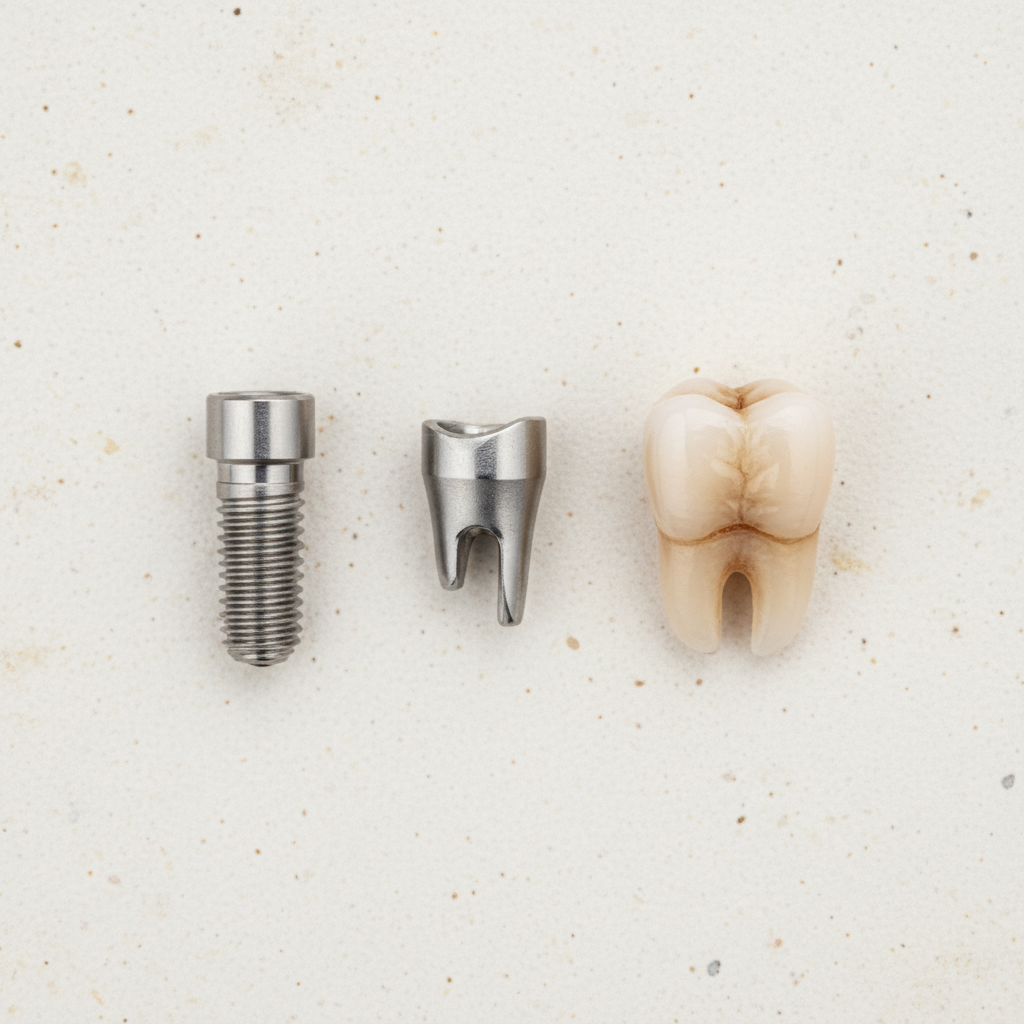
A modern dental implant has three components: the fixture (the titanium root, threaded into the bone), the abutment (the connector that emerges through the gum), and the prosthetic crown (the visible tooth). The fixture is placed surgically; osseointegration — the biological fusion of bone to titanium surface — takes 8–12 weeks; the final restoration is fitted once osseointegration is complete.
Immediate provisionalisation is the protocol that places a non-functional or partially-functional crown on the same day as implant placement. The patient leaves with a tooth in place during the osseointegration period — cosmetically intact, functionally restricted (no hard biting on the implant for 8 weeks). The definitive crown is fitted at the 3-month follow-up visit or shipped to your home dentist for placement.
We use Straumann BLX and Nobel Active systems — both with extensive published outcome data. The choice depends on the bone type, the position in the arch, and the prosthetic plan.
Same-day choreography
| Time | What happens |
|---|---|
| 08:30 | CBCT scan, periodontal assessment, occlusal analysis |
| 09:30 | Treatment plan confirmed; informed consent re-read |
| 10:00 | Implant placement under local anaesthesia (45–90 minutes for single, 2 hours for multi-unit) |
| 12:30 | Lunch break in the lounge while impressions / digital scans are processed |
| 14:00 | Immediate provisional crown fitted |
| 15:30 | Occlusion check, polish, post-operative instructions |
| 16:00 | Discharge with antibiotics, analgesics, chlorhexidine mouthwash |
| +24 h | Post-op review at the clinic |
| +3 months | Definitive crown fitting (in Istanbul or shipped to home dentist) |
Multi-unit cases (3–6 implants in one session) follow the same flow with extended surgical time. The locked daycase package includes both visits when feasible.
Single implant vs bridge vs all-on-4 — when each is right
| Situation | Recommended | Why |
|---|---|---|
| One tooth missing, healthy neighbours | Single implant | Avoids drilling healthy teeth (as a bridge would require) |
| Two or three adjacent teeth missing | Bridge over 2 implants | Replaces 3-4 teeth with 2 fixtures |
| Full arch (or near-full) missing | All-on-4 / All-on-6 | Cost-effective full-arch restoration on 4–6 implants — see our dedicated All-on-4 page |
| Aggressive periodontitis with multiple loose teeth | All-on-4 with full clearance | Better long-term outcome than salvaging individual teeth |
| Insufficient bone height for posterior implants | Bone graft + delayed implant, or zygomatic | Anchorage requires either more bone or a different anchor |
The right answer is determined by your CBCT and occlusal analysis, not by what the patient asks for.
Who is a candidate
- Adequate bone volume (CBCT-confirmed: ≥ 5 mm height, ≥ 4 mm width)
- Healthy gums — active periodontitis treated first
- No uncontrolled diabetes (HbA1c < 8% ideally)
- No bisphosphonate IV therapy in past 5 years (oral bisphosphonates discussed case-by-case)
- Non-smoker, or willing to stop 4 weeks pre-op and 8 weeks post-op
- Age 18+ (skeletal growth complete)
About 1 in 5 patients who book "an implant" leave the consultation with a different recommendation: a bridge, a referral for periodontal treatment first, or bone grafting before implant placement. This is the assessment working.
Recovery
Day 0 — Local anaesthesia wears off over 4–6 hours. Mild swelling and tenderness; manage with paracetamol or ibuprofen. Cold compress on the cheek.
Day 1 — Post-op review at the clinic. Stitches inspected, mouthwash protocol started.
Week 1 — Soft diet. No hard biting on the implant. Saline rinses.
Week 2 — Stitches removed (or self-dissolving). Most patients return to normal activity.
Week 8 — Osseointegration complete; the implant is now load-bearing.
Month 3 — Definitive crown fitted. The provisional is removed.
Year 1+ — Annual maintenance review.
What it is not
A same-day implant is not a same-day definitive. The provisional crown placed at hour 14:00 is cosmetically intact but functionally restricted for 8 weeks. The definitive restoration is fitted at month 3.
A dental implant is not a substitute for periodontal treatment. If your gums are inflamed, the implant will fail — sometimes years later, sometimes within the first year. We treat periodontitis first and place implants into healthy beds.
It is not always the right answer. For a single missing tooth between healthy neighbours, an implant is usually best. For two or three adjacent missing teeth, a bridge over two implants may be more efficient. The plan tells you which fits your case.
The package
The locked daycase package: pre-op CBCT, periodontal assessment, occlusal analysis, implant placement (single or multi-unit per plan), immediate provisional crown, post-op review at 24 hours, definitive crown fitting at month 3 (or shipped to home dentist), all medications, optional hotel night with transfers, translator, 12 months of video follow-up. One number.