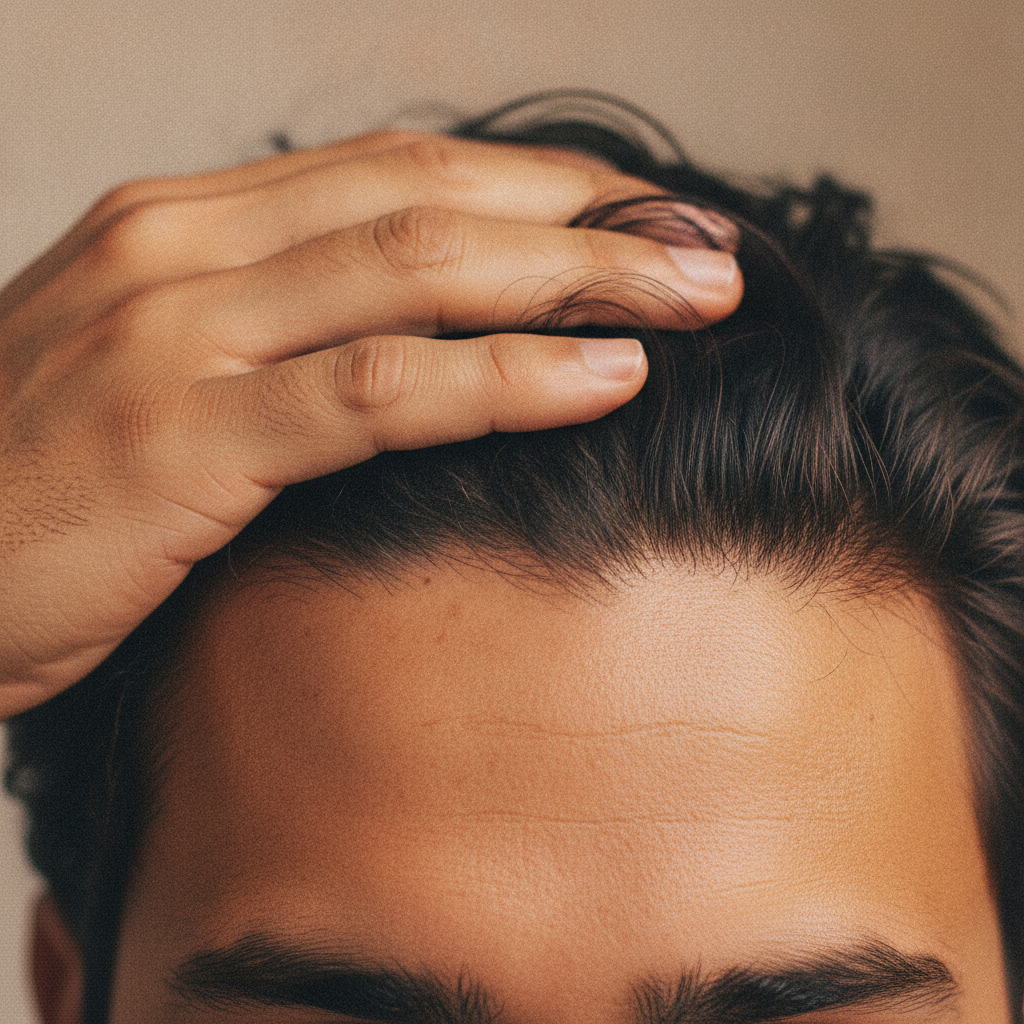
Sapphire FUE at HEC — hairline drawn at 08:00, implanted by 17:00
Sapphire FUE refers to the use of sapphire-blade microblades for the recipient-site incisions of an FUE (follicular unit extraction) hair transplant. The technique allows finer, more closely-spaced incisions, denser packing in the recipient area, and faster epithelial healing compared with stainless-steel slits.
At HEC we run hair restoration as a same-day daycase. Hairline drawn with the surgeon at 08:00, donor extraction begins at 08:30, channel opening and implantation complete by 17:30. You leave the suite with a post-op pack the same calendar day. Optional one hotel night with a wash visit at 24 hours.
What it is
Hair transplantation by FUE involves two distinct phases: extraction of follicular units from the donor scalp using a circular micro-punch, and implantation into recipient sites in the balding zone. Sapphire FUE is a refinement of the second phase. Rather than a stainless-steel slit blade for the recipient sites, the surgeon uses a microblade with a sapphire crystal tip. The cutting edge is finer, more uniform, and produces a V-shaped channel of measured depth and width.
The practical consequences:
- Denser packing. Sapphire incisions can be placed closer together without trauma to adjacent sites — up to 45–55 follicular units per cm² versus 35–45 with conventional slit blades, in suitable scalps.
- More natural anterior hairline geometry. Finer incisions at the anterior margin allow irregular single-hair placement that produces a natural-looking hairline.
- Faster epithelial healing. Sapphire incisions re-epithelialise faster than stainless-steel slits, with reduced crusting and shorter visible recovery.
The extraction phase is identical to classic FUE; the donor-site management is identical; the follicular-unit handling is identical. The difference is the incision tool.
Same-day choreography
| Time | What happens |
|---|---|
| 07:30 | Hairline drawn with the surgeon |
| 08:30 | Donor extraction begins |
| 13:00 | Lunch in the lounge |
| 14:00 | Channel opening with sapphire microblade |
| 15:00 | Implantation by the trained transplant team |
| 17:30 | Final photographs, post-op pack |
| 18:00 | Back to your hotel |
| +24 h | Wash visit at the clinic, follow-up reviewed |
Where sapphire FUE matters most
The benefit is greatest in cases where:
- Hairline design is the primary goal — refined anterior margin with closely-spaced single-hair follicular units
- High density is required in a limited recipient area (frontal forelock, mid-frontal tuft)
- Skin healing is a recovery priority — return to work or social life within 7–10 days
The benefit is less material in cases where the recipient zone is a diffuse mid-scalp or vertex area where moderate density is the goal, or where the patient has very fine donor hair, or where the total graft count is small (under 1,500 grafts).
A specialist-signed plan tells you when sapphire FUE is the right tool — not the same as marketing it as a universal upgrade.
Sapphire vs DHI / Choi — different phase, different tool
The two methods address different phases. DHI (direct hair implantation, Choi-pen technique) places harvested grafts directly into the recipient scalp without pre-made incisions. Sapphire FUE pre-makes the recipient sites with a sapphire blade, then implanters place the grafts.
| Technique | Recipient-site creation | Best for |
|---|---|---|
| Sapphire FUE | Pre-made incisions with sapphire microblade | Cases prioritising hairline design and maximum density |
| DHI / Choi | Site and placement in one step with Choi pen | Cases prioritising shorter graft-out-of-body time, unshaven recipient zones |
| Combined (sapphire + DHI in select zones) | Mixed | Larger sessions — hairline benefits from sapphire density, mid-scalp from DHI's speed |
Recovery
Day 0 — Procedure complete, post-op pack and saline spray issued.
Day 1 — Wash visit at the clinic. Crusts begin forming.
Day 7–10 — Crusts resolve. Office work resumed.
Week 2–6 — Shock loss — transplanted hairs shed, expected and transient.
Month 3–4 — Initial growth visible.
Month 9–12 — Density established.
Month 12–18 — Final outcome.
What it is not
Sapphire FUE is not a different operation. The blade material does not change the absolute number of follicles that survive — graft handling, donor quality, and the patient's biology determine that. Sapphire is a precision tool for the recipient phase.
It is not a "premium" version of FUE that all patients should pay extra for. The cases where sapphire genuinely improves the result are specific; we say which ones during the consultation.
The package
The locked one-day daycase package includes the procedure (graft count quoted in your plan), the daycase suite, all medications, optional one hotel night with transfers and a 24-hour wash visit, translator, and 18 months of video follow-up. One number, paid once. The hair restoration surgeon who performs the procedure signs your plan.